
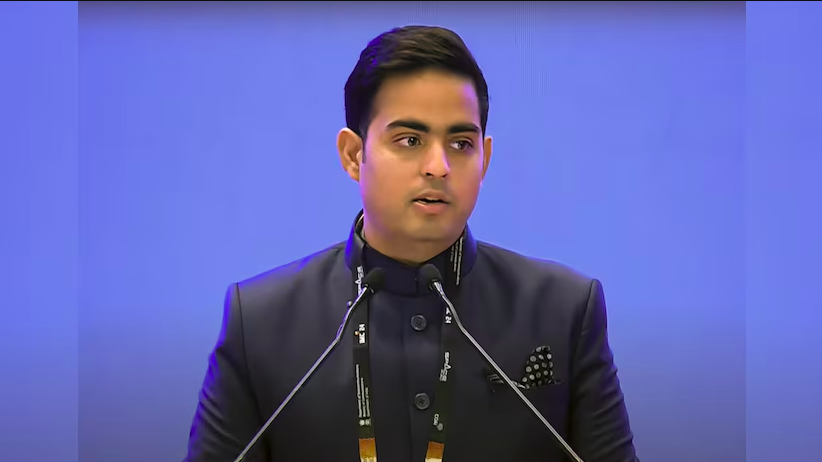
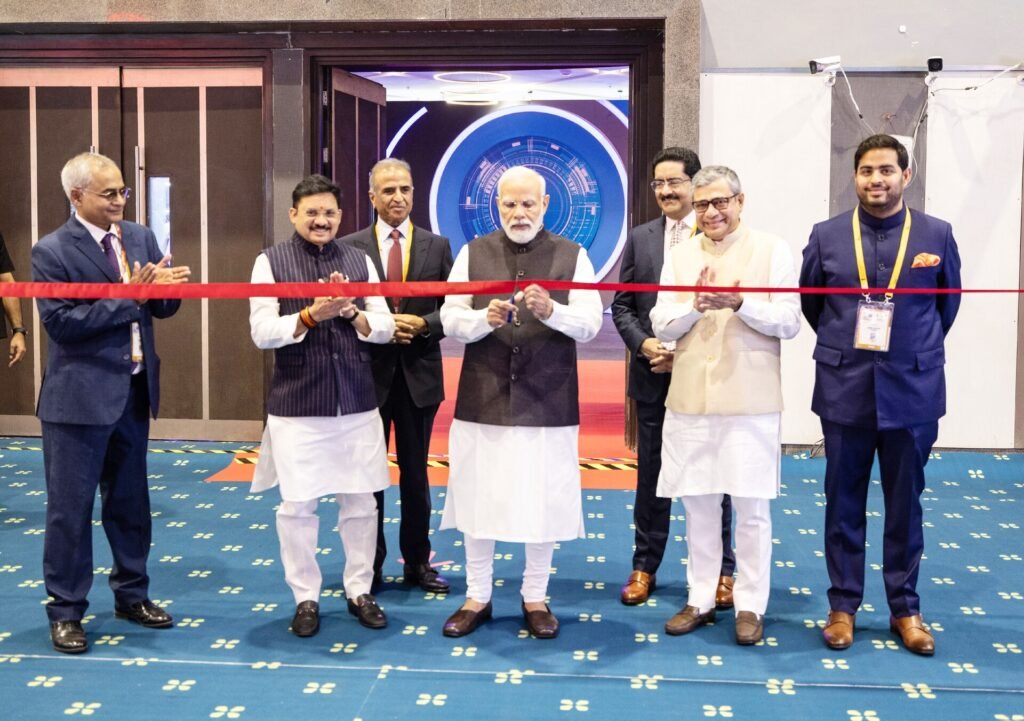
India Mobile Congress (IMC) is the country’s biggest yearly telecom and technology show. Its 2024 edition took place from 15 to 18 October at Bharat Mandapam in New Delhi, together with the ITU World Telecommunication Standardization Assembly (WTSA), the first time that global meeting was held in India. Prime Minister Narendra Modi inaugurated both on 15 October. Two speeches from the opening day got most of the attention: one by Jio’s chairman Akash Ambani on artificial intelligence, and one by Bharti Airtel’s chairman Sunil Mittal on satellite broadband. This article explains both in plain language. (For the latest edition, see our IMC 2026 takeaways.)
The short version
- Akash Ambani asked the government for a full national AI strategy, more incentives for AI data centres, and a faster data centre policy so that Indian data stays in India.
- Sunil Mittal said satellite companies that want to serve city customers should follow the same rules and pay the same kind of fees as mobile operators.
- The government’s answer: Telecom Minister Jyotiraditya Scindia said satellite spectrum would be given administratively, not through an auction, with TRAI to suggest the pricing method.
What Akash Ambani asked for
Speaking at the opening, Ambani called AI “absolutely critical” for India’s dream of becoming a developed country by 2047, and asked for a holistic AI strategy driven by self-reliance (Atmanirbhar Bharat). He made a few clear requests:
- A national AI plan. He said India should urgently adopt a full strategy for AI, not scattered steps.
- Data centre policy. He asked the government to speed up the draft data centre policy, first published in 2020. In his words, Indian data should stay in Indian data centres.
- Incentives. He said Indian companies ready to set up AI and machine-learning data centres should get incentives, including help with the cost of electricity, since these centres use a lot of power.
- Skills. He said India needs to train talent at a very large scale. On jobs, he said some existing roles will change, while many new jobs and business chances will be created quickly, much like when computers and the internet arrived.
He also said Jio wants to offer powerful AI models and services at affordable prices and is “laying the groundwork for a national AI infrastructure”.
Why data centres matter to ordinary people
A data centre is a building full of computers that store and process information, from your photos to your bank records. AI needs even more computing power. If the computers are in India, the data can be kept under Indian law and may load faster. Setting up such centres costs a lot and needs huge amounts of electricity, which is why companies ask for support. Others argue that the money should be spent carefully, and that rules should protect small companies as well as big ones.
What Sunil Mittal said on satellite spectrum
Satellite internet firms, such as the global names that want to enter India, need radio waves (spectrum) to send signals. The big question in 2024 was how to give them that spectrum. Telecom companies such as Jio and Airtel paid very large sums in auctions for their spectrum. Many wanted satellite firms to go through the same process. Global satellite players argued that satellite spectrum is shared and should be allotted by the government.
At IMC, Mittal asked for a “level playing field”: satellite companies that want to serve urban retail customers, he said, should pay telecom licence fees, follow the same conditions and buy spectrum like telecom companies do. Some reports read his remarks as a call for an auction, while Airtel later said its position had not changed and that spectrum for satellites should be allocated. Because news reports differ here, it is best to read his speech and Airtel’s clarification together.
How the government responded
Telecom Minister Jyotiraditya Scindia said at the same event that spectrum for satellite broadband would be allocated administratively, not by auction. He said the price and the formula would be worked out by TRAI, the telecom regulator. Elon Musk, whose company Starlink wants to operate in India, publicly thanked the government on X and said he looked forward to serving Indians. This debate has not gone away: see our explainer on the Starlink India launch feud.
What it means for you
- Cheaper or faster internet in remote areas is the main hope behind satellite broadband, but prices and launch dates matter more than speeches.
- AI services built in India could reduce reliance on foreign cloud providers, but that depends on how quickly policies and power supply improve.
- Data privacy is also tied to where information is stored. Data centre rules will decide a lot here.
Questions to think about
- Should satellite internet companies pay the same fees as mobile operators, even if their service works differently?
- Is keeping all Indian data inside India enough to protect privacy, or do we also need strong rules on how companies use it?
- Which matters more for your area: faster mobile networks or a new satellite option?
Related reading
- India Mobile Congress 2026: the key takeaways
- Elon Musk vs Mukesh Ambani: why the Starlink India launch has turned into a feud
- India now has 45,000 GPUs for AI: how far has the push come?
Sources
- TelecomTV: India’s top telcos apply satellite and AI policy pressure at IMC24
- Republic World: Akash Ambani on data localisation and AI data centres
- Prime Minister’s Office: inauguration of WTSA 2024 and IMC 2024
This article is a summary of public statements and news reports from October 2024 and is for general information only.