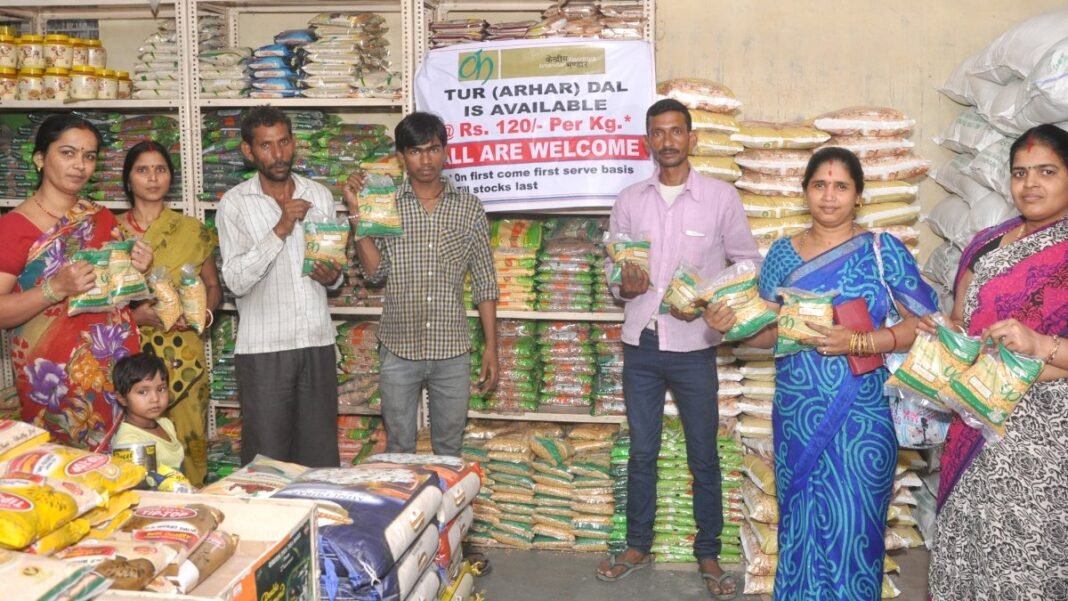
A ration card lets eligible families buy subsidised food grains through fair price shops, and it also serves as useful proof of identity and address. Ration cards are issued by state governments, so the application process differs by state.
Key points
- A ration card lets eligible families buy subsidised food grains through fair price shops, and it also serves as useful proof of identity and address.
- Under this scheme, eligible beneficiaries can collect their ration from a fair price shop in another location, including another state, using biometric verification.
- Know your entitlement before you go to the shop.
- Ration cards in India run under the National Food Security Act, 2013, which entitles eligible households to subsidised foodgrain through the Public Distribution System.
Types of ration cards
- Antyodaya Anna Yojana (AAY): for the poorest households.
- Priority Household (PHH): for families who qualify under the National Food Security Act.
- State categories: many states run their own categories, such as APL cards.
How to apply
- Go to your state’s food and civil supplies department website, or a Common Service Centre.
- Fill in the application with details of all family members.
- Upload or submit identity, address and income documents.
- Note the application number; officials may verify your details.
- Track the status on your state’s portal.
Documents commonly needed
- Aadhaar of family members
- Proof of address
- Income certificate, where required
- Photo of the head of the family
One Nation One Ration Card
Under this scheme, eligible beneficiaries can collect their ration from a fair price shop in another location, including another state, using biometric verification. This helps migrant workers who move for work. The Mera Ration app lets you check entitlements and nearby shops.
Common problems
- Name missing: apply to add a family member, such as a newborn or new spouse.
- Biometric failure: ask the shop about the alternate process.
- Delay: contact your local food office or the state helpline.
How to add or remove a family member
When a child is born, or someone marries or moves, you need to update the card. Most state portals have a form for this. You will need Aadhaar and a birth or marriage certificate. Removing a name from an old card may be needed before adding a person to a new one.
Check how much you should get
Know your entitlement before you go to the shop. Under the National Food Security Act, priority households are entitled to a set quantity of grain per person each month, and AAY households get a fixed amount per family. The Mera Ration app and state portals show your details. Ask for a receipt, and report any shortage to the state helpline.
The law behind ration cards
Ration cards in India run under the National Food Security Act, 2013, which entitles eligible households to subsidised foodgrain through the Public Distribution System. The central government sets the framework and the grain allocation, while each state or union territory prepares its list of beneficiaries, issues the cards and runs the fair price shops. That is why the card name, colour, form and eligibility rules look different from state to state.
What you receive and how it is checked
Eligible households collect rice, wheat or coarse grain every month from the fair price shop linked to their card, at the price or quantity set under the Act and by the state. Many states now use an electronic point-of-sale machine, where a family member’s fingerprint or Aadhaar authentication is taken before grain is handed over. Bring the card or its number, and the member whose details are linked. Quantities and any extra items depend on the state, so check the food and civil supplies department’s site for your district.
Aadhaar seeding and e-KYC
Linking Aadhaar to each family member’s name on the card is called seeding. It helps remove duplicate cards and is needed for biometric authentication and for portability across states. If a name is not linked, the member may be dropped from the list during verification, so confirm at the shop or on the state portal that every name shows as seeded.
What to do if your application is rejected
A rejection usually names a reason: mismatched names, missing address proof, income above the limit or a duplicate record. Fix the stated problem and reapply, or file a complaint with the district supply officer or through the state grievance helpline. Keep the acknowledgement number from the first application, because it is the quickest way to trace what happened.
Frequently asked questions
How long does it take to get a ration card?
It varies by state, often a few weeks after verification.
Can I use my card in another state?
Yes, under One Nation One Ration Card, subject to biometric verification.
Is a ration card valid as address proof?
Many offices accept it as an address and identity document, but acceptance depends on the agency. Banks and passport offices publish their own lists of accepted documents.
What is the difference between AAY and priority household cards?
Antyodaya Anna Yojana cards are for the poorest households and carry a larger fixed monthly quantity per family. Priority household cards give an entitlement per person. The exact quantities are set by the state under the Act.
Can I have a ration card in two states?
No. Holding duplicate cards is not allowed and can lead to cancellation. If you move, apply for a transfer or use the portability service instead of making a new card.
Quick tip
Check your Aadhaar is seeded to the card.
Questions to think about
- How can more migrant workers learn about portable ration benefits?
- Should food support shift to direct cash transfers, or stay as grains?
Rules differ by state. Check your state food and civil supplies portal and the national food security website. General information only.