
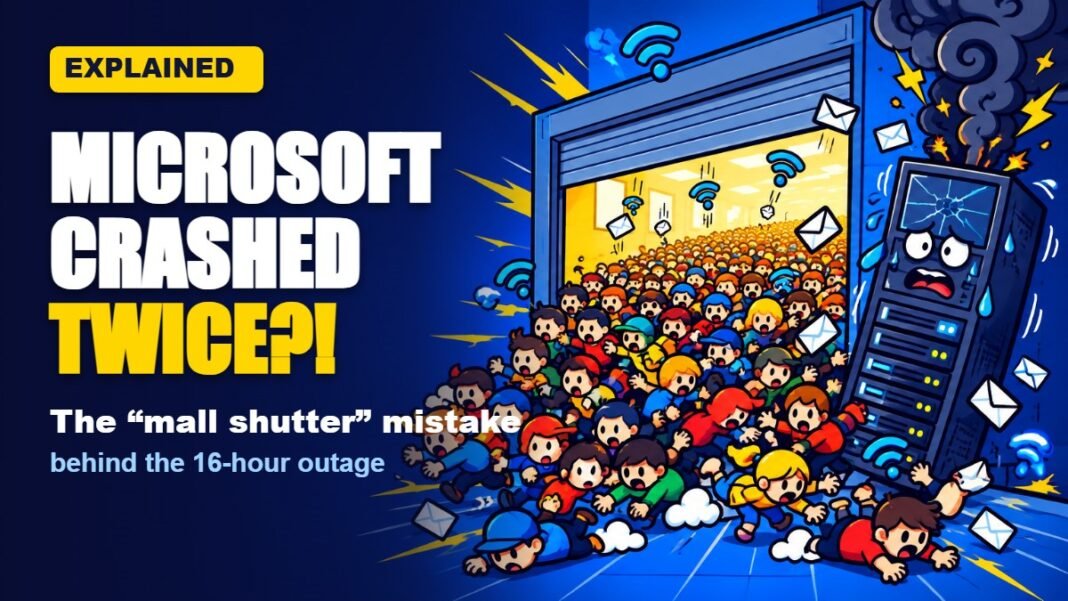
It sounds like the plot of a bad office joke: Microsoft fixed its servers, switched them back on, and they promptly fell over again. But that is exactly what happened during the outage that has kept Outlook, Teams and Copilot in trouble for more than a day, and one 60-second reel has now explained why, using nothing more than a shopping mall on sale day.
A video is making the rounds on Instagram, in which a tech creator breaks down the Microsoft outage in Hindi for people who have never heard of a server. The clip was originally posted by @ezsnippet on 13 November. It opens with the Microsoft logo and on-screen text that reads “aur 16 ghante ho chuke” (16 hours have passed), “13th Nov” and “Microsoft down: Outlook + Teams”. In the caption, the creator wrote, “Microsoft ke servers wapas on hue… aur phir se gir gaye” (Microsoft’s servers came back on… and fell again), and asked viewers whether their office or college was also stuck.
Here is what he says, in our translation. Outlook and Teams went down at 11:30 pm, and 16 hours later Microsoft was still saying it had not fixed the problem. It was not just email, he says: Teams, SharePoint, OneDrive and Copilot were all affected. He claims that email support at companies in India, including IndiGo, was also stuck, and that AI tools using Microsoft connectors, such as ChatGPT and Claude, stopped working. We could not independently confirm those last claims.
Then comes the explanation. Microsoft, he says, has said it is not a hack. Some of its servers suddenly went offline, and the ones that were left could not take the extra load, so they fell too. In technical terms, he says, this is called a cascading failure, “where the work of 10 people is being done by 3 people, and then those 3 also get tired”.
The real twist, according to the video, is that when engineers switched the servers back on, they failed again. Why? Because the moment servers come back, lakhs of users and apps try to reconnect at once, and the servers cannot handle the rush. “It is like a sale in a mall,” he says. “The shutter opens and everyone rushes in at once. It is a stampede.”
Take a look at the video here:
View this post on InstagramMicrosoft ke servers wapas on hue… aur phir se gir gaye
A post shared by @ezsnippet
Video: @ezsnippet on Instagram (embedded; the video remains the creator’s property).
The comment section had mixed feelings, and a few jokes. “It’s working now and I got 600+ mails,” one user wrote, with a sulking emoji. Another posted, “Issue is fixed after this video is released.” A third simply wrote, “Bhai ye kya hogaya mera,” along with a broken-heart emoji. One viewer asked the question many were thinking: “Kal bhi aisa hi rahega na?” (It will be like this tomorrow too, won’t it?)
Why did Microsoft’s servers fall twice?
The reel’s explanation matches what Microsoft itself has said. The company has stated that there is no indication of malicious activity. It first blamed “elevated infrastructure load”, then said servers had unexpectedly become unavailable, and later said that servers it returned to service became unresponsive once traffic reached them, so it began limiting inbound traffic and bringing it back gradually. You can read the full timeline in our report on the Microsoft outage.
Engineers have two names for the two problems:
- Cascading failure: one part of a system fails, its work moves to the parts still running, they get overloaded, and they fail too. Each failure makes the next one more likely.
- Reconnect storm (also called a thundering herd): when a service comes back, millions of devices that were waiting all retry at the same moment. The sudden spike can be larger than normal traffic, so the freshly restored servers crash again.
The fix developers use: wait a little longer, and a little randomly
The creator’s advice to app builders is simple. When your app loses its connection, do not keep retrying at fixed intervals. Make the gap between retries longer each time, and add a random delay so that not everyone retries together. Engineers call this exponential backoff with jitter. In the mall example, it is like asking shoppers to enter in small groups at different times instead of letting everyone rush in at once. If you do not do it, he says, your app will face the same problem the next time a server goes down.
The creator also says Microsoft has promised a root cause analysis. As of now, Microsoft has not published a final cause, so we will update our report when it does.
So what do you think? Is a mall shutter the best way to explain a global outage, or did your office have a better one?
Questions to think about
- Should big cloud providers bring services back more slowly to avoid a second crash?
- Would you want your company to have a backup email and chat system for days like this?
- Which everyday idea would you use to explain a technical failure to a friend?
Read next
- Jensen Huang is out: Nvidia’s founder resigns as CEO, CFO Colette Kress takes over, and Wall Street is asking what comes next
- Microsoft went down for two days, and this viral reel has ‘found’ the culprit: a Bihari who didn’t get Chhath leave
- Microsoft just went dark: Outlook, Teams and Copilot down for a second day, and your emails are stuck in limbo