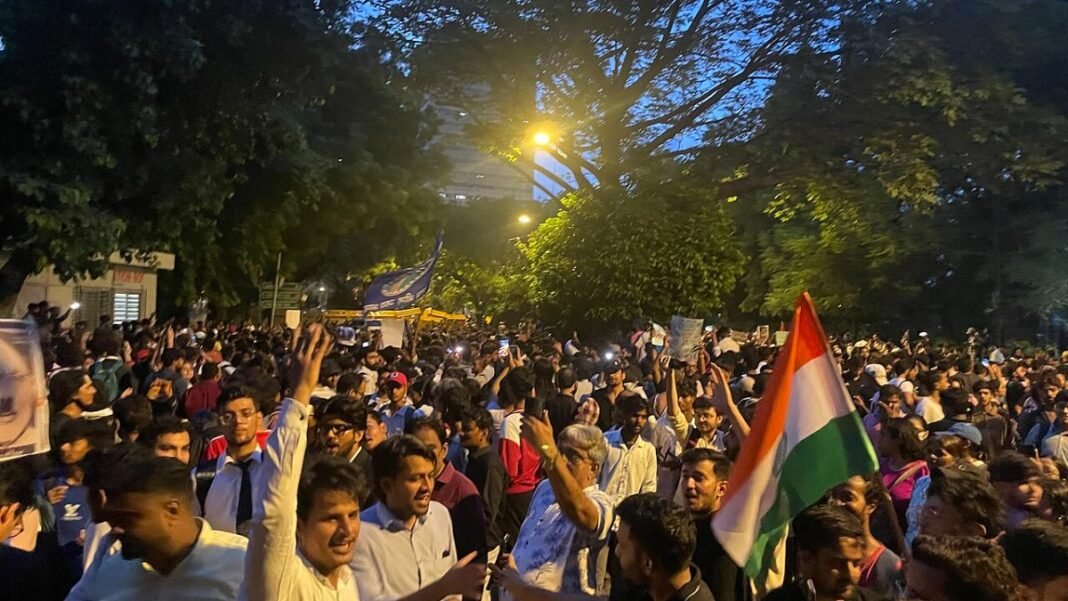
Delhi spent the weekend under heavy security as police moved to stop a big protest by the Cockroach Janta Party (CJP), a youth movement that has drawn large crowds in several cities this year.
Founder Abhijeet Dipke and other senior leaders were detained as soon as their flight landed in Delhi on Saturday. By Sunday, a court had ordered their release. “Cockroaches never die,” the group posted on X soon after, according to NBC News.
What happened on Saturday and Sunday
The CJP had planned to bring thousands of people to Jantar Mantar in central Delhi on Saturday, October 10. Delhi Police refused permission for the gathering. Barricades went up, checkpoints were set up on major roads and security forces blocked access to the venue.
The movement says thousands of its members were detained across the country, and a spokesperson put the number at “at least 10,000”, according to Al Jazeera. These figures have not been independently verified.
On Sunday, smaller groups of young protesters, many from student organisations, staged sudden protests around the city. Police detained hundreds of them for a second day. A court then ordered the release of Dipke and two other senior leaders on an undertaking to “maintain public peace”.
Some student groups have alleged that detainees were assaulted inside police vehicles. Reuters said it could not verify these claims, and Delhi Police did not respond to its questions.
What does the Cockroach Janta Party want?
The main demand is the resignation of Chief Election Commissioner Gyanesh Kumar. Protesters say a recent revision of voter lists, called the Special Intensive Revision (SIR), had irregularities that favoured the ruling BJP. The Election Commission says the revision has no political motive.
How did the movement start?
The CJP was founded in May 2026 by Abhijeet Dipke, a political communications strategist. Its unusual name comes from a remark by the Chief Justice of India, who referred to certain activists and unemployed young people as “cockroaches”. The movement turned the insult into its identity, and it has grown fast among students and young job seekers.
We covered an earlier round of protests, when 57 Delhi Metro stations were shut and mobile internet was suspended.
What happens next?
The CJP says the protests will continue, and opposition parties have announced their own protest on Monday. If you live or work in central Delhi, check the Delhi Traffic Police and Delhi Metro updates before you travel, as roads and stations near Jantar Mantar may be closed at short notice.
Questions to think about
- How should the right to protest be balanced with public order in a busy capital city?
- What would it take to resolve the concerns raised about the voter-list revision?
- How might this youth movement shape the way young Indians take part in politics?
Sources: NBC News (Reuters), Al Jazeera and Wikipedia, as of October 12, 2026. Detention figures vary by source.