
Live update: last updated 9 November 2026, afternoon IST. Readings change by the hour, so check the official Sameer app or the CPCB website for the latest number in your area.
Delhi woke up to thick smog on Monday, 9 November, the morning after Diwali 2026. The capital’s air quality index (AQI) was in the very poor range across the city, while many local stations crossed into severe. For millions of people in Delhi-NCR, the question this week is simple: how bad is the air today, and what should we do about it?
Delhi AQI today: the key numbers
- City average: Business Standard reported a city-level AQI of 368 at 7 am on Monday, with PM2.5 as the main pollutant. Outlook, citing the Sameer app, reported 366 at 6:15 am.
- 24-hour average: the CPCB bulletin at 4 pm on Sunday put Delhi at 376, according to ETV Bharat.
- Severe stations: at least 15 monitoring stations crossed 400, with Burari Crossing and Sonia Vihar among the worst at 441, Business Standard reported. ITO touched 406 early on Monday, The Week reported.
- Peak readings: ETV Bharat reported a reading of 483 at 8:10 am on 9 November.
Some private apps showed much higher numbers, including readings above 1,000 late on Diwali night. These apps use different sensors and scales from the government’s CPCB index, so their figures cannot be compared directly. The figures above come from the official CPCB network.
NCR and other cities: AQI after Diwali
| City | AQI (CPCB bulletin) | Category |
|---|---|---|
| Delhi | 376 | Very poor |
| Ghaziabad | 344 | Very poor |
| Noida | 318 | Very poor |
| Greater Noida | 299 | Poor |
| Faridabad | 291 | Poor |
| Gurugram | 288 | Poor |
| Lucknow | 233 | Poor |
| Indore | 166 | Moderate |
| Chennai | 138 | Moderate |
| Mumbai | 132 | Moderate |
Source: CPCB bulletin at 4 pm on 8 November as reported by ETV Bharat. Pune, Ahmedabad, Jaipur, Kolkata and Bengaluru also saw higher pollution after the festival, but stayed well below Delhi.
On Google, searches for “delhi aqi”, “aqi noida”, “pune aqi” and “aqi mumbai” jumped sharply over the last 24 hours, which shows how many families are checking the air before stepping out.
What the AQI numbers mean
| AQI | Category | Possible health impact |
|---|---|---|
| 0-50 | Good | Minimal |
| 51-100 | Satisfactory | Minor breathing discomfort for sensitive people |
| 101-200 | Moderate | Discomfort for people with asthma, lung or heart disease |
| 201-300 | Poor | Breathing discomfort for most people on long exposure |
| 301-400 | Very poor | Respiratory illness on long exposure |
| 401-500 | Severe | Affects healthy people, serious impact on those already ill |
Why the air got worse after Diwali
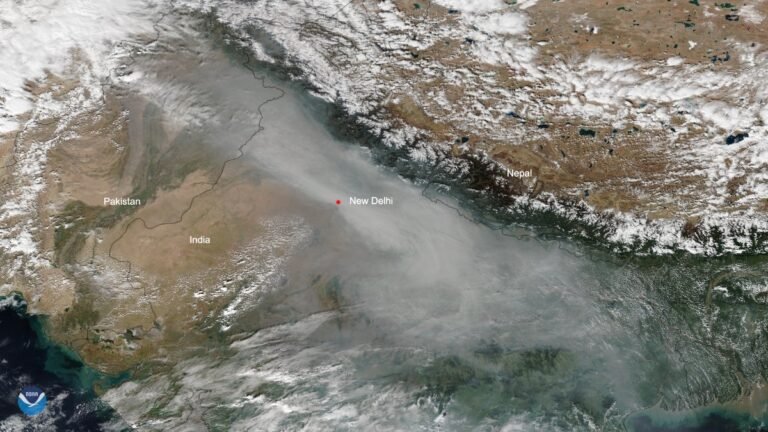
Firecrackers are only one part of the story. Officials and experts usually point to a mix of causes:
- smoke from firecrackers on Diwali night, despite the restrictions in Delhi
- vehicle exhaust and road dust
- construction and industrial emissions
- smoke from crop-residue burning in neighbouring states
- cold, still air in early November, which traps pollution close to the ground
Air quality was already very poor before the festival. ETV Bharat noted that Delhi’s AQI was 364 at 8 am on 7 November, a day before Diwali.
GRAP restrictions in force
Stage III of the Graded Response Action Plan (GRAP) has been in force across Delhi-NCR, Outlook reported. Under Stage III, authorities usually restrict non-essential construction and demolition, some older diesel and petrol vehicles, and certain industrial activity. Schools can be asked to move younger classes online. The exact rules are announced by the Commission for Air Quality Management (CAQM), so follow its latest orders.
The political debate
As every year, the pollution has turned into a political argument. Delhi Environment Minister Manjinder Singh Sirsa was reported by The Tribune as saying that the AQI rose only marginally after Diwali, while opposition leaders blamed the government for the smog. Some reports described the day after Diwali as the worst in several years. Readers can compare official CPCB data across years to judge the claims for themselves.
How pollution is affecting health
Doctors are reporting more patients with breathing problems. Dr Randeep Guleria, former AIIMS Delhi director, told ETV Bharat that he had seen close to a 20% rise in patients whose existing respiratory problems were getting worse. People with asthma, COPD and heart conditions are at highest risk, but healthy people are also reporting coughs, throat irritation and breathlessness.
An earlier observational study at a Delhi chest hospital, cited by ETV Bharat, found that respiratory admissions more than doubled in the 15 days after Diwali compared with the 15 days before it.
How to protect yourself today
- Check the AQI before going out on the Sameer app or the CPCB website.
- Avoid early morning walks and outdoor exercise while the AQI is above 300. Pollution is often worst in the early hours.
- Wear a well-fitted N95 or N99 mask outdoors. Cloth and surgical masks offer little protection against fine particles.
- Keep windows shut during peak hours, and use an air purifier if you have one.
- Watch children, older people and patients for wheezing, chest tightness or breathlessness, and consult a doctor early.
- Drink water and eat fresh fruit and vegetables. They will not filter the air, but they help your body cope.
Will the air improve this week?
It depends largely on the weather. Stronger winds or rain usually clear the smog within days, while calm and cold conditions keep it trapped. Forecasts from the CAQM and the India Meteorological Department give the best guide. We will update this page as new official readings come in.
Questions to think about
- Should firecracker rules be enforced differently, or does the focus need to shift to year-round sources such as traffic and dust?
- Would schools and offices benefit from a fixed plan that kicks in automatically when the AQI crosses 400?
- How can neighbouring states and farmers be supported to cut crop burning?
- Do you trust government AQI data, private apps, or both?