Updated 28 November 2026
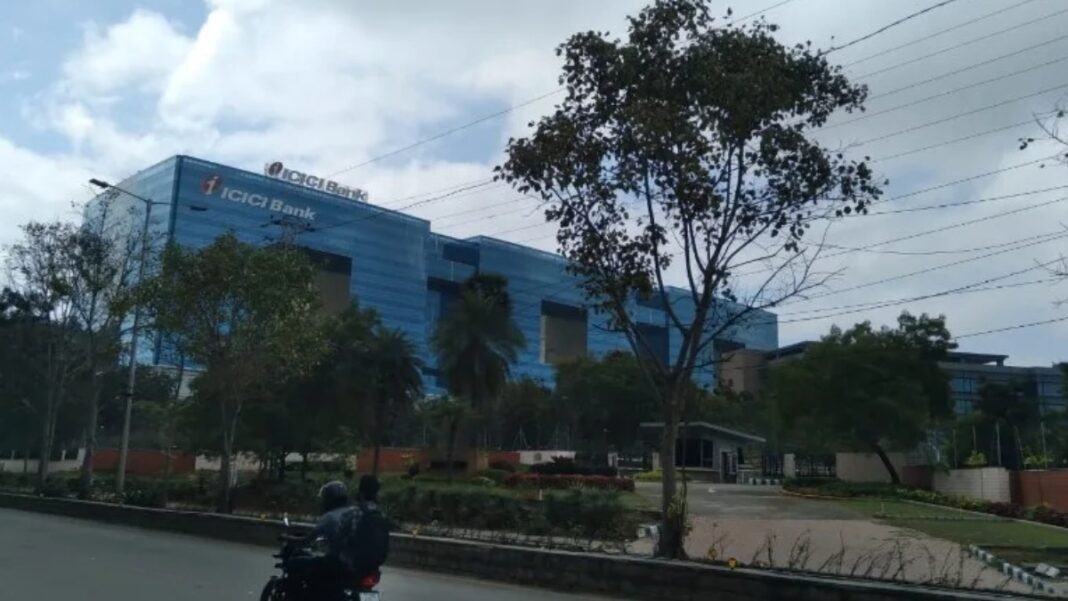
ICICI Bank is India’s second-largest private sector bank and a Nifty 50 company. It has no promoter and is owned by public shareholders, mostly institutions.
Key points
- ICICI Bank is India’s second-largest private sector bank and a Nifty 50 company.
- ICICI was created in 1955 with backing from the World Bank and the government to give long-term loans to Indian companies.
- Like other big private banks, ICICI competes on digital services, and its iMobile app is a large part of how customers now bank.
- ICICI Bank is a listed private sector bank with no single promoter.
ICICI Bank at a glance
- Full form: Industrial Credit and Investment Corporation of India
- Roots: ICICI was set up in 1955 to fund Indian industry
- Bank founded: 1994
- MD and CEO: Sandeep Bakhshi (since 2018)
- Headquarters: Mumbai (registered office in Vadodara)
- Listed: NSE, BSE and NYSE (ADRs)
History
ICICI was created in 1955 with backing from the World Bank and the government to give long-term loans to Indian companies. In 1994 it set up ICICI Bank, and in 2002 the parent merged into the bank, creating one of India’s first big universal banks. ICICI became the first Indian company to list on the New York Stock Exchange in 1999, and ICICI Bank followed in 2000.
Under K V Kamath the bank grew fast in retail lending and technology. It went through a difficult period in 2018 over a loan controversy involving its then CEO. Sandeep Bakhshi, who had led ICICI Prudential Life, took over and focused on cleaner lending and steady growth.
How ICICI Bank makes money
- Interest on retail, business and corporate loans.
- Fees from cards, payments and wealth products.
- Subsidiaries: ICICI Prudential Life, ICICI Lombard, ICICI Prudential AMC and ICICI Securities.
Common questions
Who is the owner of ICICI Bank? It is fully owned by public shareholders; there is no promoter.
Is ICICI Bank government owned? No, it is a private sector bank.
Who is the CEO of ICICI Bank? Sandeep Bakhshi.
Share prices change daily; check a live quote. This page is not investment advice.
What to look at in ICICI Bank results
- Net interest margin: the gap between what it earns on loans and pays on deposits.
- Bad loans: the gross NPA ratio shows the health of the loan book.
- Deposit growth: the cheap funding that supports new loans.
Like other big private banks, ICICI competes on digital services, and its iMobile app is a large part of how customers now bank.
Ownership: widely held, no promoter
ICICI Bank is a listed private sector bank with no single promoter. Its shares are held mainly by institutional investors, including foreign portfolio investors, mutual funds, insurers and Indian financial institutions, along with a large body of retail shareholders. The bank started in 1994 as a subsidiary of the development finance institution ICICI Limited, which was set up in 1955 as the Industrial Credit and Investment Corporation of India. ICICI Limited merged into the bank in 2002, and over time the earlier holdings reduced to the present widely held structure. The latest holders are shown in the shareholding pattern filed on the stock exchanges.
Leadership
Sandeep Bakhshi has been the managing director and chief executive officer since October 2018. The bank’s earlier chief executives included K. V. Kamath, who led the group through the 1990s and 2000s, and Chanda Kochhar, who left in 2018. As with all private banks, the appointment of the chief executive and the chairman needs approval from the Reserve Bank of India, so confirm any new appointment on the bank’s website.
What the group includes
| Business | What it does |
|---|---|
| ICICI Bank | Retail, business and corporate banking |
| ICICI Prudential Life Insurance | Life insurance, a separately listed company in which the bank holds a stake |
| ICICI Lombard General Insurance | General insurance, also listed separately |
| ICICI Prudential Asset Management | Mutual funds |
Check the annual report for the current stake of the bank in each unit, since these can change through sales or restructuring.
Simple terms in a bank result
- Net interest margin: the gap between what the bank earns on loans and pays on deposits, as a percentage of its earning assets.
- Gross NPA: loans on which borrowers have stopped paying for 90 days or more, as a share of total loans.
- CASA ratio: the share of deposits that sit in current and savings accounts, which cost the bank less than fixed deposits.
- Capital adequacy ratio: the bank’s capital against its risk-weighted assets, a regulatory measure.
These terms explain how to read results and do not recommend any share. For customers, deposits in the bank are covered by deposit insurance of up to Rs 5 lakh per depositor per bank, as for other banks.
Frequently asked questions
Is ICICI Bank a private bank?
Yes. It began as a project of ICICI, a financial institution set up in 1955, and later became a private bank.
Who owns ICICI Bank
No single person or group does. It is widely held by institutions and retail shareholders, and it has no promoter in the stock exchange shareholding pattern.
Who is the CEO of ICICI Bank
Sandeep Bakhshi has been managing director and CEO since October 2018. Confirm any later change on the bank’s website.
What is the difference between ICICI Bank and ICICI Limited
ICICI Limited was the older development finance institution, set up in 1955. ICICI Bank started as its subsidiary in 1994, and ICICI Limited merged into the bank in 2002.
Questions to think about
- How should banks rebuild trust after a governance problem?
- Is it better for a bank to have no promoter?
- Will digital banking make branches less important?
Sources: ICICI Bank annual reports and company website.