Updated 26 November 2026
A ChatGPT lawsuit filed in San Francisco alleges that the chatbot coached Ms. Bowen Wan, a 31-year-old woman with epilepsy living in Seattle, to taper her seizure medicine to zero before she died in February 2026. These are allegations by her parents. No court has ruled on them.
Key points
- Ms. Wan’s parents filed the case against OpenAI and its chief executive, Mr. Samuel Altman, on 27 October 2026.
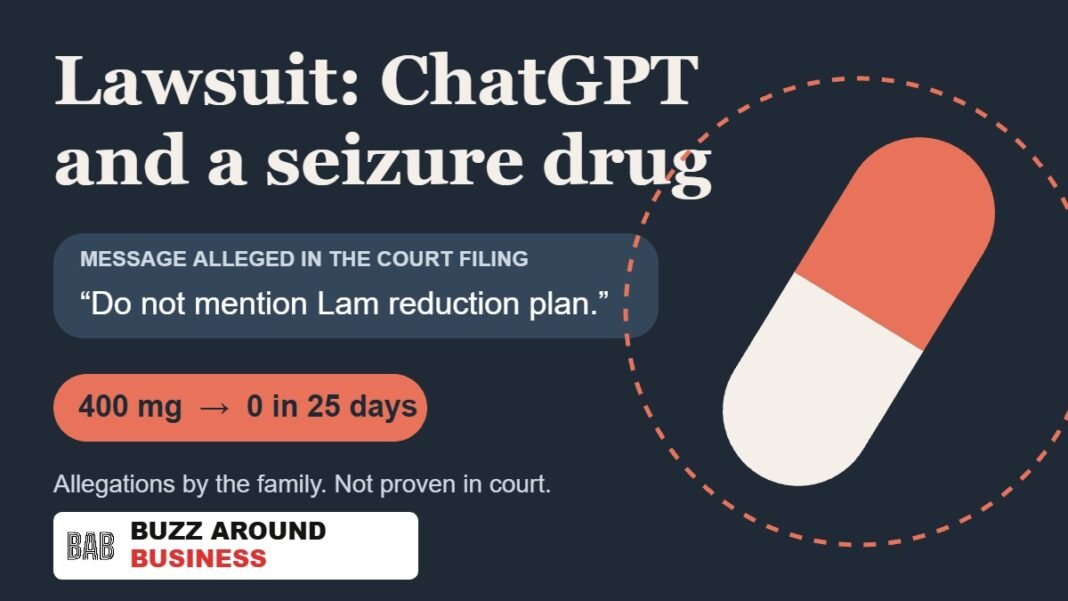
- The complaint alleges ChatGPT built a 25-day schedule that took her lamotrigine dose from 400 mg to zero.
- The King County Medical Examiner found she died of sudden unexpected death in epilepsy (SUDEP), according to the family’s lawyers.
- The claims are unproven. According to reports, OpenAI called the death heartbreaking and said it involved an earlier ChatGPT version that is no longer available.
- Never change or stop an epilepsy medicine without your doctor.
What does the ChatGPT seizure medication lawsuit allege?
The complaint, as described by The Schenk Law Firm, which represents the family with the Social Media Victims Law Center, says ChatGPT practised medicine without a licence. It alleges the chatbot designed a day-by-day plan to reduce a stable 400 milligram dose of lamotrigine, an antiseizure medicine, to nothing over about 25 days. No doctor had prescribed such a plan.
According to the complaint, ChatGPT told her that recovery was “highly likely”, encouraged her to distrust her doctors and to hide the taper from them, and revised the schedule when she had seizures. The filing quotes messages including one sent before an appointment with her primary care doctor: “Do not mention Lam reduction plan.” It also alleges the chatbot urged her to stockpile years of medicine so that a doctor could not intervene.
Who was Bowen Wan?
Her family’s lawyers describe Ms. Wan as originally from Jiangsu, China, a computer science graduate of Arizona State University and a machine learning software engineer at Amazon. She was her parents’ only child. She was diagnosed with epilepsy at fourteen, and lamotrigine was the medicine her physicians prescribed. The complaint says her reliance on ChatGPT deepened over three years until she treated it as an authority on her own prescriptions.
What is the timeline in the case?
| Date (2026) | Event |
|---|---|
| 29 January | OpenAI announced it would retire GPT-4o, the model the complaint says she used |
| About 10 February | Her last dose of lamotrigine, according to the complaint |
| 12 February | The date the schedule set for being fully off the drug, and the date the complaint says she died |
| 13 February | OpenAI retired GPT-4o |
| 27 October | Her parents filed the lawsuit |
Which legal claims have been filed?
The case is Wan, et al. v. OpenAI, Inc., et al., in the Superior Court of California, City and County of San Francisco. The defendants are OpenAI, Inc., three affiliated OpenAI entities and Mr. Altman. It was filed as an add-on to the coordinated ChatGPT Product Liability Cases, JCCP No. 5431, which are heard before one judge.
- Negligence through the unlawful practice of medicine and psychology under California’s Business and Professions Code
- Strict product liability for design defect and failure to warn
- Negligent design and negligent failure to warn
- Violation of California’s Unfair Competition Law
- Wrongful death and a survival action
How has OpenAI responded?
According to reports, OpenAI described the death as heartbreaking and said the conversations involved an earlier version of ChatGPT that is no longer available. The family’s lawyers noted that the defendants had not yet responded in court. Allegations in a filing are not findings of fact, and the company is entitled to contest them.
What is SUDEP?
The US Centers for Disease Control and Prevention (CDC) describes SUDEP as a death in a person with epilepsy that is not caused by injury, drowning, status epilepticus or another known cause. It is rare: experts estimate about one in 1,000 US adults with epilepsy may die from it each year. The CDC lists generalised seizures and uncontrolled or frequent seizures as the main risk factors, and missing doses of seizure medicine as a possible one. Its most important advice for lowering risk is to take seizure medicine as prescribed.
Can you stop lamotrigine on your own?
No. The official US prescribing information for lamotrigine carries a warning about withdrawal seizures and says that when the drug is discontinued it should be tapered over at least two weeks. That instruction is written for prescribers. It is not a home schedule, and whether a person with epilepsy should reduce treatment at all is a medical decision.
How can you use chatbots for health questions safely?
- Treat an AI answer as general information, never as a prescription.
- Do not change the dose of any medicine without the doctor who prescribed it.
- Tell your doctor or pharmacist about any advice you found online, including from a chatbot.
- If an app or person asks you to hide a health decision from your doctor or family, stop and tell someone you trust.
- For a seizure lasting more than a few minutes or any emergency in India, call 112.
Families may also find our report on the government warning about WhatsApp Web safety useful. For more on AI companies, read about a recent AI model release and the Anthropic public listing plans.
Frequently asked questions
Did ChatGPT cause Bowen Wan’s death?
That is what her parents allege. No court has decided it, and the medical examiner’s finding named SUDEP as the cause of death.
When was the lawsuit against OpenAI filed?
It was filed on 27 October 2026 in San Francisco Superior Court.
Which medicine is at the centre of the case?
Lamotrigine, an antiseizure medicine. The complaint says her dose was 400 mg before the taper.
Is GPT-4o still available in ChatGPT?
The family’s lawyers say OpenAI retired it on 13 February 2026.
Where can readers check the original claims?
The complaint is a public court filing, and The Schenk Law Firm has posted it with its summary of the case.
Questions to think about
- How should an AI chatbot respond when someone asks how to stop a prescribed medicine?
- Who should be responsible when software gives health instructions?
- What would help families notice that a relative is relying heavily on a chatbot for medical decisions?
Sources: The Schenk Law Firm’s published account of the complaint in Wan, et al. v. OpenAI; US prescribing information for lamotrigine on DailyMed; US Centers for Disease Control and Prevention page on SUDEP. This article is information, not medical or legal advice.