
Updated 11 October 2026
Shark Tank India Season 5 was the biggest one yet. The show ran from January 5 to March 17, 2026 on Sony LIV with 52 episodes and a record 13 sharks, five of them new. If one lesson stood out, it was this: founders almost never get the valuation they walk in asking for.
Key points
- Shark Tank India Season 5 ran from 5 January to 17 March 2026 on Sony LIV with 52 episodes.
- It had a record 13 sharks, five of them new; only five sat on the panel in each episode.
- Aman Gupta was again the busiest shark in the season.
- SaveSage asked for Rs 1 crore for 1% equity, and Truth & Hair asked for Rs 1 crore for 2.5% but gave away 25% for Rs 2.5 crore.
- The article’s lesson: founders rarely get the valuation they walk in with.
Meet the 13 sharks
Only five sharks sat on the panel in each episode, picked from a pool of 13.
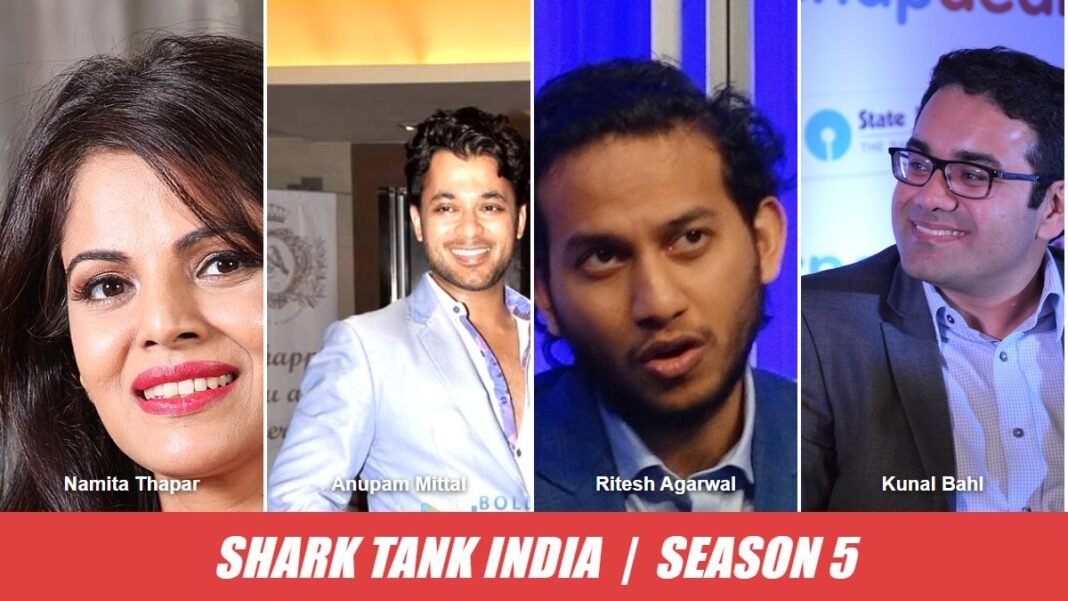
The familiar faces: Aman Gupta (boAt), Anupam Mittal (Shaadi.com), Namita Thapar (Emcure), Vineeta Singh (Sugar Cosmetics), Amit Jain (CarDekho), Ritesh Agarwal (OYO), Kunal Bahl (Snapdeal, Titan Capital) and Viraj Bahl.
The new sharks: Varun Alagh (Honasa Consumer, the company behind Mamaearth), Mohit Yadav (Minimalist), Shaily Mehrotra (Fixderma), Hardik Kothiya (Rayzon Solar) and Kanika Tekriwal (JetSetGo).
Aman Gupta was once again the busiest shark. A tracker that follows 69 direct-to-consumer brands from the season, d2c.fyi, counts 16 deals for him among those brands, followed by Namita Thapar with 14 and Anupam Mittal with 9.
The deals that stood out
SaveSage, a rewards and credit-card points app, walked in asking for ₹1 crore for 1% equity, which valued it at ₹100 crore. It walked out with ₹4 crore for 9%, the biggest cheque among the season’s notable deals, but at a valuation closer to ₹44 crore.
Truth & Hair, a curly-hair care brand, asked for ₹1 crore for 2.5%. It ended up giving away 25% for ₹2.5 crore, the biggest stake of the season.
Every Morning Cartel, a café brand, saw the sharpest drop. It asked for ₹5 crore at a ₹250 crore valuation and settled for ₹2 crore for 12%, which values it at under ₹17 crore.
Energy bar brand Mama Nourish and body-adhesive maker Get Snappy both took ₹2 crore for 20%. Oats by Goat got ₹2 crore for 8%. E-scooter leasing startup RIDEV got a mix: ₹1 crore for 3% plus ₹5 crore as a loan at 14.5% interest.
Kids’ learning brand Emomee raised ₹2 crore for 4%, valuing it at ₹50 crore, according to Indian Retailer. Aman Gupta summed up his view on the pitch: “Content is king, but distribution is god.”
What founders can learn from Season 5
Your valuation will be questioned. In the deals above, final valuations were anywhere from 17% to 93% lower than what founders asked for.
Money and valuation are a trade-off. Many founders accepted a lower valuation to get a bigger cheque.
Loans are on the table too. Sharks are increasingly mixing equity with debt, as RIDEV’s deal shows.
A handshake on TV is not the final deal. Every offer goes through checks after the show, and terms can change.
Planning to pitch? Read our guide to Shark Tank India Season 6 registration. For a look back, see our earlier piece on how the show changed the way Indians talk about investing.
How to read a Shark Tank deal
Every deal on the show can be turned into a simple valuation. If a founder gives 10% of the company for ₹1 crore, the deal values the whole company at ₹10 crore. When sharks counter with a bigger share for the same money, they are saying they think the company is worth less. Deals also often include a royalty, where the shark gets a small cut of each sale until a set amount is paid back, or a debt portion that has to be repaid with interest.
Why deals change after the show
A handshake on TV is followed by due diligence: the sharks’ teams check the company’s accounts, legal papers, sales claims and ownership. If the numbers do not match what was said on camera, or if the founders and sharks cannot agree on final terms, the deal can be changed or dropped. Some founders also decide to walk away after the show because the attention brings them other offers.
What happens to companies after airing
Many brands see a sharp jump in website visits and sales right after their episode airs. The bigger test is whether they can keep that growth when the attention fades. Founders who prepare their stock, website and customer service before the episode airs tend to benefit most. Thinking of applying yourself? Read our Season 6 registration guide.
Related reading
- Startup funding this week: Indian startups raise $123 million, DailyObjects lands the biggest cheque
Frequently asked questions
When did Shark Tank India Season 5 air?
It ran from 5 January to 17 March 2026 on Sony LIV.
How many episodes did Shark Tank India Season 5 have?
52 episodes.
How many sharks were in Shark Tank India Season 5?
A record 13 sharks, five of them new. Only five sat on the panel in each episode, picked from the pool of 13.
Which shark made the most deals in Season 5?
The article says Aman Gupta was once again the busiest shark.
Do Shark Tank deals always close after the show?
Not always. The article has a section on why deals change after the show, since the on-air offer is subject to later due diligence.
Questions to think about
- Do valuations on the show reflect what a startup is really worth?
- Is giving up a bigger stake worth getting a shark on board?
- Which Season 5 pitch did you find the most interesting, and why?
Deal details from Wikipedia’s Season 5 records, d2c.fyi and Indian Retailer. Valuations are our calculations from the reported deal terms.