Updated 26 November 2026
The Sensex rose 1,502.29 points (1.82 percent) to 83,938.28 on 25 November 2026, yet exchange data shows the gain rested on a narrow group of large companies: on the NSE, 2,050 stocks fell while 1,573 rose. Using the official Nifty 50 weights, HDFC Bank and ICICI Bank alone added roughly 169 of the Nifty 50’s 469.60 points.
Key points
- Sensex: 83,938.28, up 1,502.29 points (1.82 percent). Nifty 50: 25,819.25, up 469.60 points (1.85 percent).
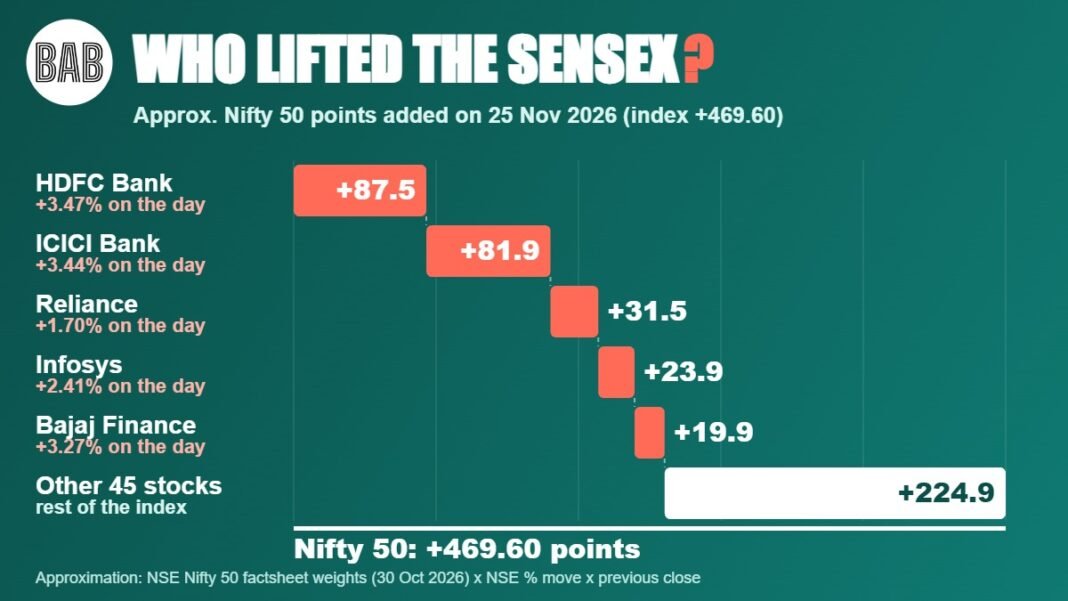
- Approximate contribution to the Nifty 50’s gain: HDFC Bank 87.5 points, ICICI Bank 81.9, Reliance 31.5, Infosys 23.9, Bajaj Finance 19.9 (weight x move x previous close).
- Hindustan Unilever was the top Nifty gainer at 6.08 percent, but with a smaller weight it added fewer points than the two big banks.
- NSE breadth: 1,573 advances, 2,050 declines, 109 unchanged out of 3,732 stocks traded.
- The exchanges publish what moved, not why. This article explains the arithmetic and gives no reason for the buying.
How did the Sensex and Nifty close on 25 November 2026?
The BSE showed the Sensex at 83,938.28 at 16:00, a rise of 1,502.29 points from the previous close of 82,435.99. The NSE showed the Nifty 50 at 25,819.25, up 469.60 points from 25,349.65, after an opening of 25,658.35, a high of 25,951.65 and a low of 25,619.00. Even the day’s low sat above the previous close. Our full session report is in Sensex Jumps 1,502 Points, Yet 2,050 Stocks Fell on NSE, and the last session before it, 23 November, is covered in our report on that day’s fall.
Which heavyweights did the most to lift the index?
An index point count is not shared equally. Each company moves the index in proportion to its weight, so a large company with a modest percentage gain can add more points than a small company with a big one. The table below uses the official weights from the NSE Indices Nifty 50 factsheet dated 30 October 2026 (the latest top-10 list in the factsheet) and the percentage moves shown on the NSE live equity page for 25 November.
| Company | Weight (%), 30 Oct | Move on 25 Nov (%) | Weight x move (index %) | Approx. Nifty points |
|---|---|---|---|---|
| HDFC Bank | 9.95 | +3.47 | +0.345 | +87.5 |
| ICICI Bank | 9.39 | +3.44 | +0.323 | +81.9 |
| Reliance Industries | 7.30 | +1.70 | +0.124 | +31.5 |
| Bharti Airtel | 5.63 | -0.52 | -0.029 | -7.4 |
| Larsen & Toubro | 4.25 | +1.37 | +0.058 | +14.8 |
| Infosys | 3.92 | +2.41 | +0.095 | +23.9 |
| State Bank of India | 3.73 | +0.49 | +0.018 | +4.6 |
| Axis Bank | 3.28 | +2.12 | +0.070 | +17.6 |
| Kotak Mahindra Bank | 3.19 | +1.22 | +0.039 | +9.9 |
| Bajaj Finance | 2.40 | +3.27 | +0.079 | +19.9 |
| Top 10 together | 53.04 | +284.2 |
How the numbers were worked out: approximate points = weight x percentage move x the previous close of 25,349.65. For HDFC Bank that is 9.95 percent x 3.47 percent = 0.345 percent of the index, and 0.345 percent of 25,349.65 is about 87.5 points. The ten companies hold 53.04 percent of the index between them and added about 284.2 points, roughly 60 percent of the day’s 469.60. HDFC Bank and ICICI Bank together gave about 169.4 points, a little over a third.
These are approximations. Weights move every day with share prices, and the factsheet figures are from 30 October, so the true contributions on 25 November will differ slightly. The remaining 40 stocks, including Hindustan Unilever, Tata Consumer Products and Nestle India, account for the balance of about 185.4 points. Hindustan Unilever closed at 2,141.80, up 6.08 percent from 2,019.10, the biggest gain in the index; because it sits outside the top ten, its weight is below 2.40 percent, which caps its contribution at about 37 points on the 30 October weights. The factsheet lists weights only for the top ten, so no figure is given for it. The contribution table above covers the Nifty 50 only; for Sensex weights, refer to the index factsheet published for the Sensex.
How is an index weighted, and why does that matter?
The NSE Indices factsheet says the Nifty 50 is computed with the free float market capitalisation method. In plain words, a company’s influence depends on the market value of the shares actually available to the public, not on its name or its share price. The index has 50 companies and is rebalanced twice a year, according to the same factsheet. The 30 October sector table also shows how concentrated it is: Financial Services carried 37.13 percent, Oil, Gas and Consumable Fuels 9.00 percent and Information Technology 8.80 percent, while Fast Moving Consumer Goods carried 5.36 percent.
So a move in a few banks shifts the index more than the same move in a dozen smaller names. That is arithmetic, not a judgement about any company.
Why did the Sensex jump while more stocks fell than rose?
Two different counts are being compared. Inside the Nifty 50, 42 stocks rose and 8 fell, so the index’s own constituents were broadly higher. The NSE market statistics cover all 3,732 stocks traded that day, and there the decliners (2,050) outnumbered the advancers (1,573). The 50 index stocks are a small slice of that list, and they are the largest by value.
A made-up example shows how this can happen. Take an index of five companies with weights of 40, 20, 15, 15 and 10 percent. If the 40 percent company rises 3 percent and the other four each fall 0.5 percent, the index changes by (40 x 3 minus 60 x 0.5) divided by 100, which is a gain of 0.9 percent, even though four of the five fell.
| Index (NSE) | Close | Change on 25 Nov (%) |
|---|---|---|
| Nifty FMCG | 50,143.50 | +3.79 |
| Nifty Pharma | 28,961.90 | +2.38 |
| Nifty Private Bank | 31,337.95 | +2.21 |
| Nifty Financial Services | 28,764.95 | +2.17 |
| Nifty Bank | 63,703.25 | +1.79 |
| Nifty 500 | 24,025.40 | +1.17 |
| Nifty Midcap 100 | 61,584.75 | +0.30 |
| Nifty Smallcap 100 | 19,229.35 | -0.44 |
| Nifty Metal | 11,578.50 | -2.04 |
Among the 50 index stocks, the decliners were Tata Steel (down 2.27 percent), Max Healthcare (1.22), Hindalco (1.17), JSW Steel (0.72), Shriram Finance (0.60), Bharti Airtel (0.52), ONGC (0.38) and Adani Enterprises (0.35). Other large gainers included Tata Consumer Products (up 4.66 percent), HDFC Life (4.58), Nestle India (4.03), IndiGo (3.57), Bajaj Finance (3.27), ITC (2.74), Infosys (2.41) and TCS (2.33). At the other end of the market, the NSE reported 65 stocks at a 52-week high and 185 at a 52-week low.
Do the exchanges say why buyers came in on 25 November?
No. The NSE and BSE pages show prices, volumes, index levels and market statistics. They do not state reasons for a day’s moves, and this article does not assign one. What the data does show is where the move happened: banks, FMCG and a few large names rose, while metals and smaller companies lagged. For a company-specific explanation, the place to look is the company’s own filings on the exchange websites. For example, our profile of HDFC Bank covers who owns it and how it is structured.
What does this mean for a small investor?
It depends on what you hold. Suppose, purely as an illustration, that someone held Rs 1,00,000 in a fund that mirrored the Nifty 50 exactly. A 1.85 percent day would mean a paper gain of Rs 1,850 before costs. Someone holding Rs 1,00,000 in a basket that mirrored the Nifty Smallcap 100 would have seen a 0.44 percent fall, a paper loss of Rs 440. The headline Sensex number said the market “jumped”, but the two portfolios had different days. Real funds track their indices with small differences and charge fees, and one session says little about the next.
If you are new to investing, the first step is a trading and demat account; our explainer on how a demat account works covers the basics. This article is information, not investment advice, and nothing here suggests buying or selling any stock or fund.
Frequently asked questions
Why did the Sensex jump 1,502 points on 25 November 2026?
The BSE shows the Sensex closing at 83,938.28, up 1,502.29 points. Exchange data shows large Nifty companies, especially HDFC Bank, ICICI Bank, Reliance and Infosys, rose, and with their large weights that lifted the index. The exchanges do not give reasons for price moves.
Which stock contributed the most to the Nifty 50’s gain?
On the 30 October weights, HDFC Bank, with about 87.5 points, followed by ICICI Bank at about 81.9. These are approximations from the official weight table.
Can the index rise when more stocks fall?
Yes. Indices are weighted by size, so a handful of heavyweights can outweigh many small decliners. On 25 November the NSE recorded 2,050 decliners against 1,573 advancers while the Nifty rose 1.85 percent.
What is the difference between the Sensex and the Nifty 50?
The Sensex is the BSE’s index and the Nifty 50 is the NSE’s. They are separate indices with different constituents, so their points and percentage changes differ slightly, 1.82 percent and 1.85 percent on this day.
Where can I check the official index weights?
NSE Indices publishes a factsheet for the Nifty 50 with sector weights and the top ten constituents, and the BSE and NSE websites carry the day’s closing data.
Questions to think about
- When an index rises on a few large companies, how should an investor read the gain against the number of stocks that fell?
- How concentrated is the Nifty 50 in a few sectors, and what does that mean for someone holding only an index fund?
- Does the day’s gain in the Nifty 50 tell a smallcap investor anything about their own portfolio?
- Should a one-day move of 1.8 percent matter more or less than a year of returns when judging a market?
Sources: National Stock Exchange of India (live equity market, index watch and market statistics pages, 25 November 2026, 16:00 IST); BSE Ltd (home page Sensex data, 25 November 2026, 16:00); NSE Indices Limited, Nifty 50 factsheet dated 30 October 2026. Approximate contribution figures are BAB calculations from these official sources.